Flying Near Nashville: What Student Pilots Need to Know About Class C Airspace in 2026

Published by:
Matt Wilkins
Published on:
Updated on:
Read time:
8 min read
When you take your first cross-country flight out of our Shelbyville hangar, you will look down at your sectional chart and see Nashville’s airspace rings printed in bold magenta. For a lot of students, that magenta ink looks intimidating. But I tell my students the same thing every time: that airspace is not a roadblock. It is one of the best training classrooms you will ever find.
Understanding Class C airspace and learning how to fly in, near, and straight through it is a critical skill for any pilot. If you are researching flight training near Nashville, you need to know how airspace will shape your training long before you ever book a discovery flight.
Here is how we guide you through this airspace at Hawkins Flight Academy, and why our location gives you a massive advantage.
Demystifying Nashville’s Class C Airspace
Nashville International Airport (BNA) is the heart of our regional airspace, classified by the FAA as Class C airspace to keep busy commercial jet traffic separated from general aviation. Think of it as an upside-down wedding cake: a core cylinder extending 5 nautical miles from the airport, and a shelf reaching out 10 nautical miles with a lower floor.
To fly into Class C airspace legally, you must establish two-way radio communication with Air Traffic Control (ATC) before you cross the boundary.
I always tell my students that establishing two-way communication has a very specific legal definition: ATC has to say your specific tail number. If the controller says, ‘RV-two-eight-alpha-hotel, standby,’ you have established communication and you are clear to enter. If they say, ‘Aircraft calling, standby,’ or ‘unable,’ you must stay clear.
We make sure you know exactly how to handle these rules so that the Nashville airspace feels like familiar territory instead of a stressful boundary.
Why Training at KSYI Gives You a Standard-Setting Start
We chose Shelbyville Municipal Airport (KSYI) as our primary training base because it is a non-towered airport, and that offers a massive learning advantage for new students.
When you are first learning to control the airplane, the last thing you need is a busy controller barking instructions in your ear while commercial jets line up behind you. At KSYI, we teach you to self-announce your positions, scan for traffic, and manage the pattern in a focused, high-discipline environment. The radio is still highly active and the pattern is busy, but the pacing allows you to build solid fundamentals before we layer on live ATC communication.
We do not look at non-towered training as an easier route. We treat it as a critical foundation. It builds:
- Impeccable radio discipline by teaching you to speak clearly and announce your position at every key point in the pattern
- Proactive traffic scanning habits so you are actively looking for other aircraft with your eyes instead of waiting for a controller to point them out
- Strict pattern geometry by letting you focus on holding precise altitudes and airspeeds without constant air traffic control adjustments
By the time we fly you closer to the Nashville airspace corridor, these core habits are second nature. You are not trying to learn how to fly the airplane and talk to ATC at the same time. You are just adding ATC to a cockpit that you already run with absolute confidence.
Our Fleet is Fully Equipped for Modern Airspace
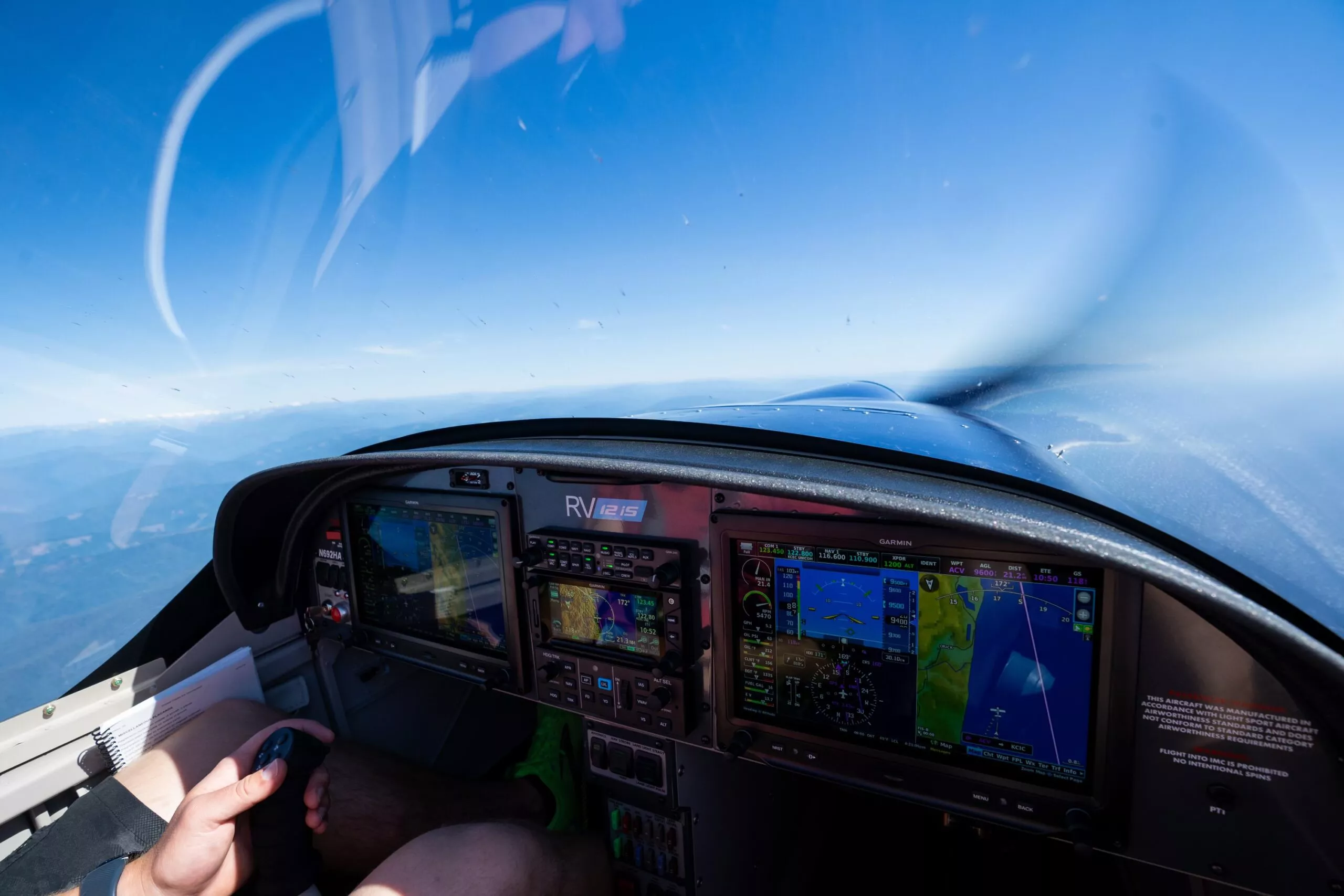
Under 14 CFR 91.225, ADS-B Out equipment is mandatory to operate anywhere within or near Class C airspace. When you train with us, you do not have to worry about whether your airplane is legally allowed in the airspace. Every single RV-12 in our standardized fleet is fully equipped with advanced ADS-B In and Out technology.
We also use ADS-B In to feed live traffic data directly onto your Garmin G3X cockpit screens. It gives you an incredible safety margin by letting you see traffic in the area, reinforcing the visual scanning habits you build at Shelbyville.
If you are comparing flight schools near Nashville, always ask about the fleet’s avionics. An older training airplane without ADS-B Out is legally locked out of the best training airspace in the region. We invest in modern glass-cockpit standard systems so you can fly anywhere with complete peace of mind.
Getting Your Towered-Airport Requirements Done Right
Here is a detail that surprises a lot of people: under 14 CFR 61.109, you must complete at least 3 takeoffs and 3 landings to a full stop at a towered airport before you can take your private pilot checkride.
We do not leave this requirement to the last minute. We build towered operations directly into your syllabus. When you are ready, you and your instructor will fly into towered environments together, practicing radio calls and pattern work until it feels routine.
By integrating this early, you are not scrambling to find tower time at the end of your course. Your cross-country routes naturally expose you to the exact communication environments you need to practice, turning a required checkride box into a natural part of your growth.
Rehearsing the First Radio Call on the Ground
That first live call to Air Traffic Control can make your heart beat a little faster. It is not because the words are hard, but because you are trying to balance holding your altitude, scanning for traffic, and speaking clearly all at once.
To make sure you are totally comfortable, we have you practice these calls in our Redbird simulators first. We sit down and run through the exact phraseology, tail numbers, altitudes, and positions in a stress-free environment on the ground.
When you finally key the mic in the actual airplane, it does not feel like a high-pressure moment. It feels like something you have already done dozens of times.
Note: While simulator practice is an invaluable tool for building radio and system confidence, the exact hours that can be logged toward your certificate requirements depend on the specific FAA-approved device and how the session is conducted. We always make sure you get the maximum training value out of every simulator session.
How We Use Nashville Airspace as a Training Asset
When you are searching for flight training near Nashville, you are probably focused on cost and scheduling. You probably are not thinking about airspace classes. But the moment your instructor pulls out the sectional chart to plan your first solo cross-country, airspace becomes very real.
The students who excel are the ones who build a strong framework early. Here is the practical guide we use to help you master the airspace:
| Airspace element | What we teach you | Why it matters to your safety |
|---|---|---|
| Class C communication | Establishing two-way radio contact and tail number acknowledgment | Required by 14 CFR 91.130 to legally operate near BNA |
| Towered-airport operations | Tower communications, taxi clearances, and pattern sequencing | Fulfills the mandatory towered landings required under Part 61 |
| ADS-B equipment | Reading cockpit traffic displays and understanding transponder codes | Legally required for Class C; significantly increases situational awareness |
| Sectional reading | Identifying floors, ceilings, and radio frequencies on the map | Essential for planning safe, legal cross-country flights |
| Non-towered habits | Managing pattern spacing and self-announcing without a tower | Builds the self-reliance and cockpit discipline needed for towered fields |
If you are looking to map out your flight training investment, we want to make the process as stress-free as possible. We offer flexible financing options through our partners at Stratus Financial and AOPA Finance. I encourage you to check out our financing page to see which packages align with your personal budget so you can train with absolute focus.
Airspace Questions I Hear From Nashville Students
Will I have to fly into Nashville International (BNA) during my training?
You do not have to. While BNA is our primary local Class C airport, the Part 61 towered airport requirement can be completed at several other towered fields in the area. We typically take you to airports that give you excellent towered practice without the high-pressure sequencing and delays of a massive commercial hub.
Is Class C airspace dangerous for a student pilot?
Not at all, as long as you are prepared. The rules are simply there to keep everyone separated and safe. Once you understand the communication requirements, verify your aircraft’s ADS-B equipment, and review your sectional charts, Class C airspace becomes just another tool in your toolkit. Our job is to build that comfort level step-by-step so you never feel overwhelmed.
Do I need an instrument rating to fly in the Nashville area?
No, you do not. You can fly within Class C airspace under Visual Flight Rules (VFR) with standard two-way radio contact and the correct aircraft equipment. Many of our students do choose to pursue an Instrument Rating after their private certificate because it opens up incredible career opportunities and safety margins, but it is a separate training milestone.
What do I do if ATC tells me ‘unable’ when I request entry?
It is simple: you stay outside the boundary and follow their instructions. It is a completely normal part of flying near busy airports. We train you on exactly how to navigate around the airspace, establish a holding pattern if needed, and coordinate with controllers to find a safe route home.
How does airspace training fit into your courses at Hawkins?
We build airspace literacy into your training from day one. You will study it in your very first ground school session and apply it practically on every cross-country flight. Whether you enroll in our Private Pilot Course or our comprehensive Professional Pilot Program, we design our training to build the exact navigation skills and real-world ATC confidence you need to operate safely near any major city.
Let’s Get You in the Cockpit First
If you are researching flight schools near Nashville, the absolute best first step is to experience the cockpit for yourself rather than just reading about it.
A Discovery Flight at Hawkins Flight Academy gives you 30 to 45 minutes of hands-on flight time with an FAA-certified instructor, a detailed pre-flight briefing, and a personalized post-flight sit-down to discuss your training goals. You will get to fly our modern aircraft, meet our team, and see exactly what it feels like to fly near Nashville with a team that has your back every mile of the way.